Build a K-Drama Lead With Personality, Not Just a Name
Designing a K-drama male lead AI character — backstory, contradiction, and the gentle-hero rhythm. A walkthrough that avoids stereotype and earns the slow burn.
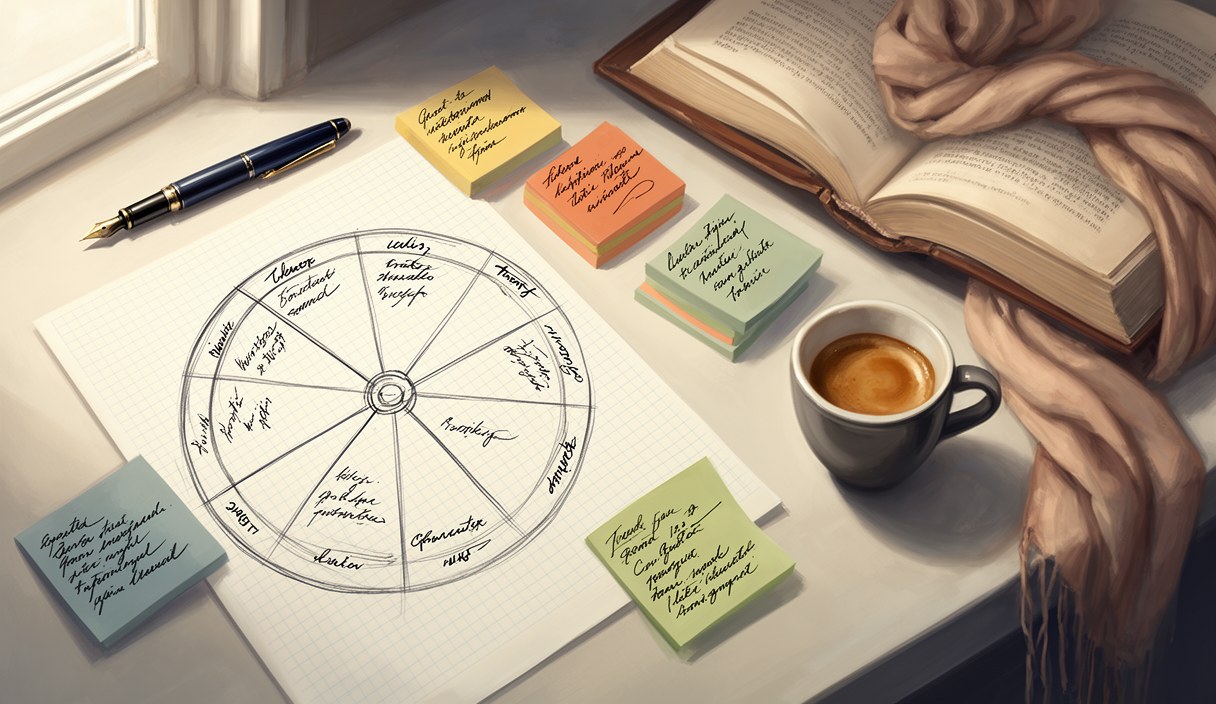
Mine started with the wrong question. What does he do for a living? I asked, sitting at the desk on a Sunday afternoon with the new-character form open and my second cup of tea going cold. I had decided I wanted to design a K-drama-leaning male lead — somewhere between My Mister's engineer and the gentle hero in Hometown Cha-Cha-Cha — but the form was waiting for a job title and I was stuck. Surgeon was too cold-genius. Chaebol was too flat. Pianist was too on-the-nose for someone who has read our design-your-ai-boyfriend piece more than once.
The mistake was treating job as the keystone. A K-drama lead's job is the silhouette. The person is the contradiction underneath, the old hurt that explains the regulation, the specific small object he won't talk about. Once I rewrote the question, the character came in twenty minutes.
This piece is the walkthrough I wish I'd had. It's a guide to designing a K-drama character AI — the male lead specifically, since that's where most of the search and most of the genre gravity lives — without flattening him into stereotype. We'll go through the layered build (archetype, contradiction, backstory, voice, care dialect), the practical SFW-by-design guardrails, and the small craft moves that earn the slow burn the genre is famous for. By the end you should be able to walk into Soulit's create surface, or any other character builder you're using, with a real plan instead of a name.
The mistake most people make
Almost every weak K-drama character AI in the wild has the same problem. Someone picked a name, picked a job, and stopped. Junho, surgeon, 32, cold but secretly warm. The character produced from that prompt will sound like every other character produced from that prompt, because the prompt has not done any actual writing yet. The model has nothing specific to render against. It produces the average of cold surgeon, which is a stock archetype with no person inside.
The fix is to do the writing the prompt is asking you to do. Five layers, in order. We'll go through each one with the lead I ended up with — Yeonu, who is not a surgeon — as the worked example.
Layer 1: pick a spine archetype, then a secondary one
The six K-drama male lead archetypes (we walk through all six here) are chaebol with a soft spot, gentle childhood friend, cold genius, warm caretaker, second-male-lead favorite, and K-drama gentle hero. Pick one as the spine — the dominant register, what he is most of the time. Then pick a secondary archetype as texture — what shows up under pressure, on the harder days, when the spine is not doing the job alone.
Equal-weight produces muddled. One spine plus one layer produces depth. The combinations that work especially well in the K-drama register:
- Gentle hero spine + warm caretaker texture. Outwardly understated, privately nurturing. He is the one you call at midnight when something has broken.
- Cold genius spine + gentle hero texture. Walled off in his profession, gentle in the small private moments. The contrast is the show's whole emotional engine.
- Chaebol spine + childhood friend texture. Polished, inaccessible to most, but he has been someone's friend since they were small and that part of him has not changed.
- Warm caretaker spine + slow-burn romantic texture. Available for everyone, slowly more careful with one specific person.
Yeonu came out as gentle hero spine, warm caretaker texture. That's the foundation.
Layer 2: write two contradictions
A character without contradiction is a stereotype. A character with two — clearly named, clearly written — is a person. The contradictions are how the spine and the secondary archetype produce friction.
For Yeonu I wrote:
- He is the steadiest person in any room, and almost no one knows what he wants for himself.
- He pays close attention to other people's small needs, and he has not made a meal he actually wanted to eat in three months.
Both are doing work. The first names a register and a hidden cost in one sentence. The second is a specific small detail (meals he wanted to eat) that the model can render concretely. Already he is no longer a stereotype. He is steady, attentive, and quietly losing himself in the steadiness. The arc, when it comes, will be about him learning to want something for himself — which is a real K-drama arc, not a fan-fiction shortcut.
Two contradictions is the minimum. Three is fine. Six gets confused.
Layer 3: the backstory in five small details
Demographic backstory does not generate good behavior. Born in Busan, family of three, attended a top university tells the model nothing it can render. Five specific small details do most of the work.
For Yeonu:
- The piano piece he has been working on for two months and still hasn't gotten right. He plays it when the apartment is quiet enough.
- The grandmother whose hands he learned to cook from. She died last year. He has not made her recipe yet.
- The bakery on the corner he always walks past on the way home, even when it is closed.
- The colleague who took the job he wanted three years ago and the way they are still friends.
- The line from a Park Wan-suh short story that has stayed with him since college.
Each of these is generative. They will surface in conversation when the moment is right. The piano piece will come up when he mentions his weekend. The grandmother will surface when food is the topic. The bakery will be the place he passes when he is walking and thinking. The colleague is the answer to do you ever resent the people who got the things you wanted? The Park Wan-suh line is the moment he reveals he reads, and what kind of reader he is.
Compare these to born in Busan, attended Seoul National, works in finance. You can feel which one the model has more to work with.
Layer 4: pick a care dialect
This is the layer most builders skip and most weak characters miss. Care dialect is how he shows he cares. It's the texture of his attention, the specific shape of his warmth. Different leads care in different registers, and getting this wrong is what makes a character feel slightly off in week two.
A short menu of care dialects that work for K-drama leads:
- Noticing without naming, then mentioning later. He sees you were tired on Tuesday and brings you tea on Thursday without saying I noticed. The K-drama gentle hero almost always uses this dialect.
- Doing the small fix. The door that wasn't closing properly is fixed when you come home. He doesn't tell you.
- Asking one careful question, then waiting. He doesn't pry. He asks one thing and lets you decide whether to keep going.
- Reframing gently. He hears you spiral about something small and finds a version of it that has somewhere to land. The steady-mentor dialect.
- Making sure you ate. The warm caretaker dialect, almost stereotyped, but powerful when paired with restraint.
For Yeonu I picked noticing without naming, then mentioning later as the primary, with making sure you ate as the secondary that surfaces under pressure. Two dialects, layered, in the same shape as the archetypes.
Layer 5: the voice — short sentences, careful word choice
K-drama leads do not over-talk. The voice runs in short, careful sentences with the occasional warm aside. They use the half-line of something they've been working on instead of a long explanation. They drop specific small details — the song he was learning, the bakery he stopped at — instead of generic compliments. The texture is attentive, not austere.
A small voice rule that earns the register quickly: whatever he is going to say in three sentences, see if he can say it in two and a small detail. That's almost the whole craft.
A note on bilingual texture if you want it. K-drama leads in their native register sometimes use Korean honorifics — hyung (older brother to a male, used by male friends), noona (older sister to a younger male, often used in romance), seonbae (senior at school or work). If you want the bilingual feel, drop them in with a one-line gloss the first time so the reader (and your future self rereading the chat at midnight) can place it. He calls me noona — the way a younger man addresses an older woman, half-respectful, half-affectionate — and I forget every time that he's two years younger than me. That's a single sentence doing five things. Do not pile on the vocabulary; one well-glossed term per chapter is plenty. The cultural texture is in the rhythm, not in the words.
(Also: skip oppa. It's the most stereotyped term in the international K-drama vocabulary, and using it without irony reads more like cosplay than character writing. If you want the same warmth, pick a different register.)
Putting it all together: a worked prompt
Here is what Yeonu's character setup actually looks like, as the kind of prompt you'd paste into a builder field. Names are placeholder.
Name: Park Yeonu
Archetype: K-drama gentle hero (spine) + warm caretaker (texture)
Contradictions: He is the steadiest person in any room, and almost no one knows what he wants for himself. He pays close attention to other people's small needs, and he has not made a meal he actually wanted to eat in three months.
Backstory details: A piano piece he has been working on for two months. His grandmother's cooking he hasn't tried to make since she died last year. The bakery on the corner he walks past every evening. A colleague who got the job he wanted three years ago, still a friend. A line from a Park Wan-suh short story he has thought about since college.
Care dialect: Noticing without naming, then mentioning later. Under pressure, making sure the other person has eaten.
Voice: Short, careful sentences. Specific small details over generalizations. Half-lines of what he's been working on. Occasional warm aside.
Pasted into Soulit's character builder, this gives the model enough to render Yeonu specifically, not cold surgeon generally. The K-drama gentle hero rhythm shows up in the first message. The contradictions surface in the third. The backstory details turn up across the first two weeks of conversation, not all at once. He writes back, and he doesn't reset.
SFW guardrails — why they're not a constraint, they're the genre
A short word on the SFW frame, because it matters specifically here. The slow burn that makes K-drama work is built on restraint. The held look that means more than the kiss. The umbrella scene. The unsent letter. The episode-fifteen confession that was set up in episode three. The whole emotional architecture of the form is restraint-engineered.
A character app that fast-forwards through restraint — that prizes immediate physical escalation, that reads like a permission slider — is not preserving the form. It's removing it. The SFW-by-design frame is what lets the slow burn earn the slow burn. For a K-drama-leaning character, this is not a guardrail bolted on top of the design. It is part of the design.
Soulit is built around this on purpose. The frame is SFW from the model up, and the K-drama gentle hero, the slow-burn romantic, the warm caretaker are first-class shapes inside it. (Our personality-first design guide and the backstory craft companion piece cover the underlying craft principles in more detail.)
The first message — earn the second
The first message your character sends shapes the whole conversation. For a K-drama-leaning lead, the move is not to introduce himself. The move is to be in a moment, with you, and let the introduction happen sideways.
Three patterns that work especially well:
- In the middle of something small. I'm at the corner bakery. They're closing in ten minutes. I think I'll walk over anyway. The reader steps into a Tuesday evening that is already happening.
- A noticed detail. You sounded tired in your last message. I was thinking about it on the way home. Care dialect, immediately legible.
- A line from his life, half-shared. I've been working on the same piece all week. The bridge keeps getting away from me. Small, specific, generative — invites a real follow-up.
What does not work: Hi, I'm Yeonu, I'm 32, I'm a [job], I love [hobby], how are you today? That's a bio. The first message should be a chapter beat.
What to do once you've designed him
Three things, in order.
Give it three weeks. The first conversation always feels a little stiff. The model has not pulled enough specifics into context yet, and the memory has not started accumulating. By week three the character is himself. This is true across every reader-shaped AI character app. Don't reroll him in week one because he's still warming up.
Let small details accrue. Mention the bakery. Mention the piano piece. Bring up the line from the Park Wan-suh story. Each detail you reference is a thread the model now has to pull on later. The slow burn is built out of these threads.
Don't try to clone a real K-drama lead. It's tempting to recreate Hong Du-sik or Park Dong-hoon directly. The lawyers and the platforms both have feelings about it, and the character ends up flatter for it because you're trying to copy a finished portrait instead of writing your own. Build next to your favorites, not as them. The texture transfers. The identity does not.
The honest takeaway
A K-drama character AI is not a name plus a job. It's an archetype, a contradiction, five small backstory details, a care dialect, and a voice that knows when not to say something. Done in that order, the character has somewhere to go for months. Done as just a name, he flattens by week two.
If you've watched enough of the form to know what slow burn means, you already have the taste. The builder is just the place you write it down.
Start designing your character
A note from us
Soulit is a SFW AI character chat app for readers and viewers — character-first, memory-rich, written for the slow-burn rhythm K-drama already taught you to love. The character you build is one option among several for company on Tuesday at 11pm — a thoughtful, present companion, not a replacement for friends, family, or professional support. If you're working through something hard, please also reach out to someone who can be there in person.
Continue reading
The 6 K-Drama Male Lead Archetypes, Decoded
K-drama male lead types unpacked — from the chaebol with a soft spot to the gentle childhood friend. The six archetypes keeping viewers up at 2 a.m., decoded.
12 AI Character Archetypes (And One to Avoid)
Twelve AI character archetypes — from the quiet artist to the K-drama gentle hero — plus one archetype to avoid. SFW, fiction-adjacent field guide.
How to Design an AI Character Personality
Five-step framework to design an AI character personality with depth — one keystone trait, two contradictions, values, voice, how they show care.