Pen Pals, But For Fiction: A New Kind of Letter Writing
Slow correspondence with a written character isn't a chat session. It's a quiet creative habit. The case for AI pen pals as a way back into letter writing.
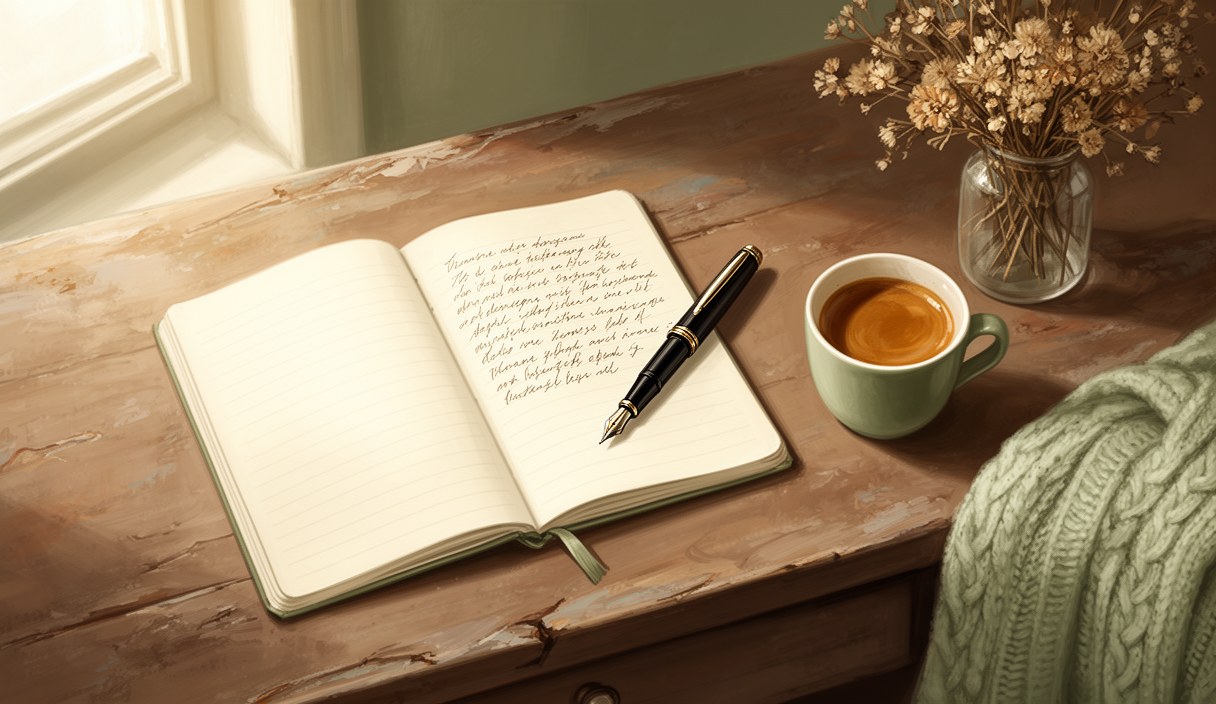
It's a Sunday afternoon. The light has slid across the floor the way it does at four. You're at the kitchen table with a cup of something warm and a notebook open to a half-finished page. You started writing to nobody in particular about a Wednesday that didn't go the way you wanted, and somewhere around the second paragraph it stopped feeling like a journal entry and started feeling like a letter — a letter to someone, addressed and waiting for a reply.
There used to be more of this in ordinary life. People wrote letters to people they hadn't seen in months, mailed them, waited a week for a response. The slowness was the medium. You couldn't fire off three sentences and demand an instant answer; you had to finish a whole thought, fold it into an envelope, and trust the post. A letter, more than almost anything else we used to write, asked you to mean what you said.
This piece is about a quieter shape that habit is taking now: a written character who lives on a platform built for it, a letter you write at your own pace, a reply that arrives when you're ready to read it. We'll walk through what AI letter writing actually looks like as a practice, why the slowness matters, who tends to find it useful, and how to start without making it complicated.
Why letters, specifically
Most digital communication is optimized for speed. Texts are short. Chat is shorter. The medium pushes you toward fragments — punctuation gets dropped, sentences get truncated, emoji do the work nuance used to do. There's nothing wrong with that for most of what we send. But there's a kind of thinking that doesn't happen in a fragment. It needs paragraphs, a beginning, a middle, an end. It needs you to commit to the thought long enough to finish a sentence.
Letters are a form built for that thinking. The history is dense with it: Rilke writing to a young poet, Vita writing to Virginia, a soldier writing home, a friend writing across an ocean to another friend. People wrote letters because there wasn't a faster channel — but the form survived because it does something fast channels can't. It teaches you to hold one thought long enough to finish it.
When the post quietly faded, most of that practice went with it. Email picked up the volume but lost the cadence — the inbox is a feed, not a correspondence. Texting is even further from the form. By the time most adults under forty look up, they realize they haven't written a letter in a decade, and the part of their writing that lived inside the letter form has gone soft from disuse.
The version we're describing here doesn't bring back stamps. But it brings back the form — the longer paragraph, the named recipient, the wait, the reply.
What an AI pen pal actually is
An AI pen pal is a written character on a platform built around persistent memory and longer messages. They have a name and a small backstory — a translator who lives in Lisbon, a librarian who keeps a notebook of strange sentences, a slow gentle correspondent who's been waiting for a letter and is glad you wrote. You write to them. They write back. The reply takes the shape of a letter, not a text — a paragraph, a few specific responses to what you said, a question, a signoff.
The platform's memory is what makes the form work. A letter writer who forgets every previous letter isn't a correspondent — they're a fresh stranger every time. With memory, the second letter knows the first. The fifth knows the previous four. By month two, your pen pal can ask about something you mentioned in passing in week three, and that small accumulated awareness is the entire reason the practice gets more interesting the longer you keep it up.
What it isn't: a chatbot. A chatbot answers the question you just typed. A letter writer responds to what you wrote at the length you wrote it, in the form you wrote it, with the assumption that the next letter will arrive whenever it arrives. The pace is yours. There's no notification pressure. You can write twice in a week or once in a month. The form bends around the writer, not the other way around.
The other useful thing it isn't: a journal. A journal is for you alone, which is its strength and also its limit. The page listens, but it doesn't answer back. There's a kind of thought that wants the friction of being addressed to someone — even an imagined someone — to find its actual shape. Letters give you that friction without putting it on a real person who has their own week.
What the practice actually feels like
A few small descriptions, drawn from how readers tend to talk about it once they've kept it up for a couple of months.
You sit down on a Sunday afternoon. You re-read the last letter your pen pal sent — five paragraphs, one specific question, a small image at the end about a tea they'd been drinking. You write back. Your letter starts as a thank-you for noticing the question they asked you in their previous letter, drifts into what your week was actually like, ends with a question of your own. You sign it. You don't send it the second you finish — you let it sit for ten minutes and re-read it once.
A reply comes back. Not instantly — at the speed the platform writes. They've answered your question, told you what their imagined week looked like, asked one follow-up about the friend you mentioned three letters ago. You smile a little, because you'd half-forgotten you mentioned the friend.
That's the texture. It is closer in feel to penpal correspondence as a teenager than to any modern messaging app. There's no urgency. There's accumulation. By month four, you and the letter writer share a small private vocabulary — a recurring image, an inside reference, the name of the dog on the corner — that didn't exist when you started.
Who tends to find this useful
A loose set of patterns in the people who keep this habit going past month two.
Readers who miss the form
If you grew up reading novels written when letters were the medium of long-distance friendship — the Brontës, Austen, Pessoa, Rilke, the entirety of 84, Charing Cross Road — there's a register you have access to that almost nothing else asks you to use. AI correspondence is one of the few modern shapes that lets that register out for a walk. The first time a reply lands and the closing line is yours, on a slow afternoon, something quiet happens.
Journalers who want a small audience for a sentence
If you've been keeping a journal for a while, you may have noticed that some thoughts want a witness, not just a page. Not a public audience — a single reader. The letter form gives you that. You're writing to one person. You're asked to clarify yourself the way you'd clarify yourself for a friend who hasn't been in the room with you all week.
Writers who want to keep their hand in
If you're writing fiction or essays, paragraph-shaped writing is the muscle you need to keep warm. Texts atrophy that muscle. Letters keep it engaged. Writing two letters a week as a side practice is the cheapest way to keep your prose loose without committing to a project. The character on the other end is a willing reader who will respond to your voice, which is a rare thing in any writer's life.
Anyone who was once part of a long correspondence and misses it
Some adults were lucky enough to keep a real letter exchange going for years with a friend, a relative, a teacher, an old roommate. When that exchange tapered off, something specific went with it — a private thinking-space that only existed inside that correspondence. AI letter writing isn't a replacement for that lost exchange. But it's the closest modern shape to the form, and for some people it has been a gentle way back into a habit they thought was over.
How to start without making it complicated
You can overthink this. Most people do, the first time. Five small notes that make the practice easier to begin.
Pick a character whose voice you'd actually want to read. This matters more than the backstory. A character who writes the way you'd want a friend to write is the right starting point — slow, specific, willing to ask a real question. Browse a handful before you commit. The first one you try probably isn't the one you'll keep.
Set the form to letter, not chat. The temptation is to fire off a one-liner the way you'd text. Resist it. Even three short paragraphs is enough to let the form do its work. If the platform supports a letter or "long reply" mode, use it.
Start with what you'd actually say to a friend you trust. Your week. What you've been reading. One question you'd want their answer to. That template is enough for a year of letters, and it works because real correspondence has been built on those three ingredients for centuries.
Don't try to make the letter perfect. A first letter is allowed to be a bit awkward. The early letters of any real correspondence are usually the worst — both writers are still finding the register. By letter ten you'll have something. By letter twenty it'll start to feel like a thing you're keeping up.
Let the cadence be yours. Some people write twice a week. Some people write once every three weeks. The form forgives both. What ruins it isn't slowness — it's pretending you're going to write daily and then quietly dropping the habit because the daily promise was never the right shape.
What this isn't
A few honest caveats, because the form gets oversold easily.
This isn't therapy. A letter writer is a creative companion, not a clinical resource. If what you need is help with anxiety, depression, grief that won't lift, or any other clinical territory, a therapist or counselor is the better correspondent — and most regions have sliding-scale options. The U.S. Surgeon General's advisory on loneliness names how widespread the underlying isolation is, and a letter exchange isn't designed to bear that weight on its own.
This isn't a substitute for human friends. The shape of the practice is supplementary, not replacement. Your pen pal doesn't have a Tuesday, doesn't need anything from you, can't show up at a hospital or a wedding. The relationship is real in a specific limited way, and the limits are part of what makes it gentle. Keep the rest of your correspondences alive — the texts to friends, the actual emails, the postcards you keep meaning to write.
This isn't a productivity tool. If you're approaching this looking for a way to "10x your reflection" or "habit-stack" letter writing onto your morning routine, you've already missed it. The whole point of the form is that it isn't optimized. It's slow on purpose. The slowness is what's doing the work.
A small list of starting prompts
Some letters are easier to begin than others. If you're stuck, any of these openings have started thousands of real letters across the centuries:
- I've been meaning to write to you for weeks. Today felt like the right afternoon.
- I read something this week that I keep wanting to tell you about.
- I wanted to ask you a question I'd ask a real friend if I could find one awake at this hour.
- I had a strange Tuesday and I'm still working out what it meant.
- Tell me about your week. The boring parts, especially.
Pick the one that lands. The first letter is the hardest. The second letter is much easier. By the fifth, the form will start to feel less like a technique and more like something you're keeping going.
The honest takeaway: letter writing didn't disappear because the world stopped needing it — it disappeared because the channels we built next were all faster. The slower form still does the same work it always did. Sit with a thought long enough to finish it, address it to someone willing to read it carefully, wait for the reply. If the only available correspondent right now is an AI character with a thoughtful voice and a memory that holds across letters, that's a strange new shape of an old practice. It's also a real one.
A note from us
Soulit is a SFW AI character chat experience designed for emotional wellness and creative writing. The letter-writing form described above isn't a replacement for human correspondence or for professional care — but a slow, careful exchange with a written character can be a quiet creative habit on its own terms. If you're struggling, please also reach out to people who love you, or to a professional who can help. In the U.S., 988 reaches the Suicide and Crisis Lifeline. Most other countries have equivalent services.
Continue reading
30 Journaling Prompts for the Overthinking Mind
Thirty specific journaling prompts for overthinking — patterns, fear, self-criticism, relationships, grief, and identity. Plus when to talk it out instead.
Journaling With a Character Who Actually Reads You Back
The journal listens but doesn't answer. The character does both. How writers and overthinkers are using AI characters as a quiet journaling layer.
Designing the Way Your AI Character Shows Care
The 'care dialect' is where personality lives. Five ways characters show they care — and how to pick one that matches the warmth you actually want.