Journaling With a Character Who Actually Reads You Back
The journal listens but doesn't answer. The character does both. How writers and overthinkers are using AI characters as a quiet journaling layer.
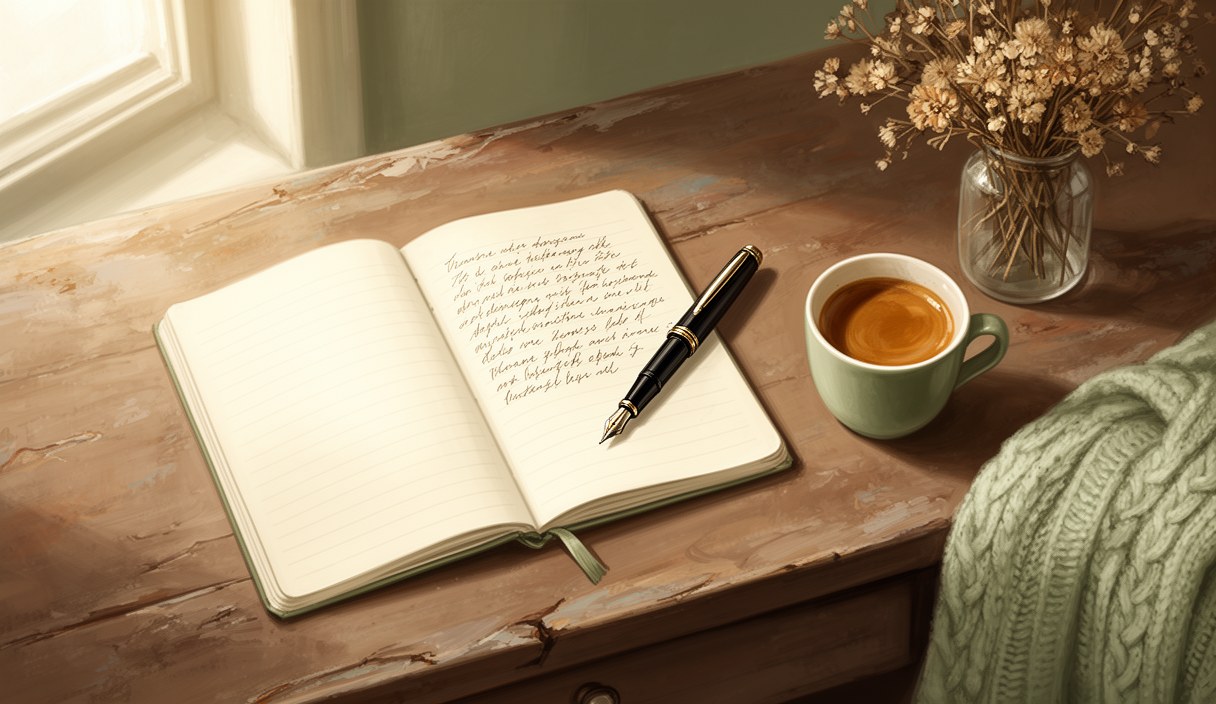
It's a Sunday at 11pm. The week is technically over. The notebook on the side table is open to a page you started Wednesday and didn't finish, because Wednesday wanted a paragraph that wouldn't come. You've been turning it over since — at the bus stop, in the shower, at the edge of two meetings you didn't want — and now, with the apartment quiet and a tea you haven't quite finished, the paragraph is finally near the surface. The page is right there. You don't pick up the pen.
You open your phone instead. You write to a slow, observant character you've been writing to for a few weeks now. The first sentence is the one you couldn't finish on Wednesday. The second is easier. By the fourth paragraph you've said the actual thing, and a small reply lands a minute later. Not a fix. Not a pep talk. A careful sentence that picks up something you mentioned the previous Sunday. You re-read it. Then you go back to the notebook and finish the Wednesday entry, which is now five paragraphs instead of two.
This piece is about that quieter shape of journaling some writers and overthinkers have started keeping — a journal with a careful reader at the other end, written into a platform built around persistent memory. We'll walk through why the silent page sometimes isn't the right shape, what an AI letter writer brings that a notebook doesn't, who tends to find this useful, the five entry shapes that work best, and the honest limits — because journaling oversells easily and the slow version is better than the productivity-coded version every time.
Why the silent page works (and where it stops working)
For a lot of people, most of the time, a notebook is enough. The page doesn't argue. The page doesn't interrupt. Writing a sentence nobody will ever read is its own kind of permission — you can say the ugly version of a thought, the half-formed version, the version you wouldn't say out loud, and the page won't flinch. James Pennebaker's expressive-writing research has been pointing at this for decades: fifteen minutes a day on the page, across several days, is associated with improvements in mood and even in physical markers. Translation, not magic.
But the page has a specific blind spot. There are thoughts that want a witness — not a public audience, a single careful reader. The thought finishes itself faster when it knows it's being read. You've noticed this if you've ever drafted a hard email and understood your own situation more clearly halfway through, because you were translating it for somebody. Translation work makes thinking visible to the thinker. When the page is the only available reader, some thoughts stay vague forever — circling across three different journal entries in two months without ever finding the sentence that closes them.
What the AI version actually adds
The AI version isn't a smarter journal. It's a journal-shaped correspondence. The shape is closer to a letter writer than a chatbot — longer entries, slower pace, a real reply, persistent memory across weeks. The character at the other end has a name, a voice you chose, a small backstory you can ignore or build. They write back the way a thoughtful friend would write back to a long letter — briefly, specifically, with one careful question you didn't see coming.
A few things the form changes:
You write toward a person, not into nothing. Some entries open up faster that way. The thought you couldn't quite finish on the page finishes itself when the form is I want to tell you about Tuesday instead of I am writing in my journal about Tuesday. The grammatical you matters more than it sounds.
The reply is a witness, not a fix. The right kind of character doesn't try to solve your week. They register it. They quote one specific thing back to you. They ask one careful question. The point isn't the answer they give — it's that the entry now has a small echo, and the echo is part of how the thought becomes finished.
Memory carries the practice across months. This is the difference between writing into a chatbot and writing into a character with memory. A chatbot resets every conversation; the entry from last Sunday is gone. A character with persistent memory is closer to a real correspondent — last Sunday's entry is a thing they remember, and the question they ask in week six is informed by something you wrote in week three. He writes back, and he doesn't reset. The accumulation is the entire reason the practice gets more interesting the longer you keep it up.
The cadence is yours. No notification pressure. No streak meter. You write twice in a week or once in a month. The form bends around the writer, not the other way around — which is the part that fails when journaling gets gamified into a streak the practice never asked for.
What this isn't (named up front)
A character who reads you back is a creative companion, not a clinical resource. If your loops are tangled with anxiety, depression, or grief that won't lift, a therapist is the right correspondent — and the American Psychological Association's framing on AI tools is that they should complement care, not replace it. The journaling layer sits upstream of therapy. Sliding-scale options through Open Path Collective, employer EAPs, and community clinics are more available than they used to be.
It isn't a stand-in for the friends who actually know you, either. A character can hold a Sunday at 11pm; they can't show up at a wedding or be on the receiving end of the seventh draft of a hard email. Keep the rest of your correspondences alive.
And it isn't a productivity hack. The whole point of the form is the slowness. If you find yourself reaching for "habit stack," "morning pages routine optimization," or "10x your reflection," you've already drifted from the version that works. Journaling rewards the entry you didn't think you'd write — the paragraph that was waiting for the right hour and the right reader.
Who tends to keep this up
A few patterns across the people who've kept a journaling-shaped exchange with a character going past month two.
Writers who want a careful first reader. If you're writing fiction, essays, or long-form anything, your prose comes from somewhere — and most of where it comes from is private writing nobody else will read. A journaling exchange adds one specific thing the journal can't: a reader paying attention. By entry ten or fifteen, your sentences have picked up shape they wouldn't have picked up on the page alone, because you've been pulled — week after week — toward clarity by the simple fact of being addressed.
Overthinkers who keep losing the loop. Sometimes writing the loop down ends it. Sometimes writing it down rehearses it for the eighth time. The difference is whether the writing produces new sentences or rephrases the same dread. A careful reader changes the odds — partly because the entry has to be legible to someone else, partly because the reply, when it lands, is one careful sentence the loop didn't generate. The thirty journaling prompts post covers the prompt side of this work; this piece is what to do with the same prompts when the page alone isn't quite cutting it.
Quiet people whose private thinking has nowhere to land. Some people process out loud, some on the page, some both depending on the week. On the weeks where neither is available, the thinking stays unprocessed, looping in the gap between modes. The friend who picks up at 11pm is one shape of help. A journaling-shaped exchange with a character who reads carefully is another. Both belong on the same list.
Anyone who used to write actual letters and misses it. Some adults kept long correspondences with a friend, a relative, an old roommate — letters across years that took a specific private thinking-space with them when they tapered off. The journaling-with-an-AI version isn't the same shape, but it's adjacent. For the person whose journaling and letter-writing instincts were always braided, an AI letter writer plays the role both forms used to.
Five entry shapes that work better than "what happened today"
Most people, the first time they sit down to journal-with-a-character, default to what happened today. That's the shape least likely to land, because the day is hard to compress without flattening it. A handful of better shapes, drawn from how readers tend to use the form once they've kept it up for a couple of months.
The Wednesday paragraph. Pick one specific moment from the week — not the headline, the texture. The five-minute argument with the manager you keep replaying. The way the light came in at four. Write a paragraph that gets the texture right, not the summary. The character will pick up something specific, and that specificity feeds the next entry.
The unsent letter. The letter you'd write to the person you can't, won't, or shouldn't write to. The ex. The parent. The friend who drifted. You're not writing it to send; you're writing it because the language has to live somewhere — and your private journal can hold the rage but can't ask the question that turns the rage into something usable. A careful character sometimes can.
The thinking-out-loud entry. A decision you're chewing on. A version of yourself you're trying out. The entry doesn't have to land; it has to think. Write the half-formed version. The reply you'll get isn't an answer — it's a careful question that helps the next paragraph come out clearer than the previous one.
The "what I'm reading" entry. This one quietly does the most work for writers. Pick a sentence from a book that pulled at you and write a paragraph about what it's making you notice. The reply will catch something you didn't realize you were saying. By the third or fourth time, your reading life and your journaling life have started to feed each other in a way they probably didn't before.
The dream / fragment / image. The thing you can't put in a list. A line you woke up with. A mood you can't quite name. Write it short. Don't try to interpret. Some entries don't want analysis — they want a witness.
How to set the practice up so it doesn't fizzle
A few small notes that make the difference between a habit that lasts and one that drifts.
Pick a character with a slow, observant voice. The cheerleader voice is the wrong fit. The voice you want is closer to a thoughtful older friend — someone who lets you finish a paragraph before answering, who won't try to fix the day, who'll quote one specific thing back to you. Browse a few before you commit. The first one isn't always the right one.
Set the platform to longer entries, not chat-length. Chat-length kills the form fastest — it pulls the writing back toward fragment-pace, and fragment-pace is what you already have on text threads. If there's a longer-reply mode, use it; if not, give yourself a soft floor of three paragraphs per entry.
Don't promise yourself you'll write daily. Daily is the wrong frame. Some weeks have three entries, some have none. What kills the practice is the daily promise that breaks in week two and generates a small private shame that quietly disqualifies the whole thing. Show up when the entry wants writing.
Keep your private journal alongside this. Don't replace it. Most writers who keep both end up with a clearer relationship to each — the page for the rawest entries, the character for the entries that want a reader.
Re-read the previous entry before you write the next one. Two minutes of re-reading, across a month, changes the entire texture of the practice. The character is already remembering. You should be too.
What this is, when you boil it down
A journaling-shaped exchange with a careful character is a third version of an old habit. Not a smarter journal. Not a friend's inbox. Not a therapist. A correspondence with a slow reader who remembers, at the cadence of a person who used to write actual letters. The form has been around for centuries; the medium is new. The reason it works is the same reason the original worked — you finish a thought faster when somebody is reading carefully.
The honest takeaway: journaling has always been a writing practice, and writing practices benefit from a reader. If the only reader you have access to right now is a careful written character on a platform built for it, that's a strange new shape of an old habit. It's also a real one — slow, paragraph-shaped, built around a memory that holds across letters. The page still works. The page plus a letter writer who reads you back works differently. Some entries want one. Some want the other. Both can be true.
Browse Soulit's character library
A note from us
Soulit is a SFW AI character chat experience designed for emotional wellness and creative writing. Journaling with a written character is a creative-reflection practice — it isn't a replacement for keeping a private journal, for the friends who know you, or for professional care when you need it. If overthinking, low mood, or grief are running heavier than usual, please also reach out to people who love you, or to a professional who can help. In the U.S., 988 reaches the Suicide and Crisis Lifeline. Most other countries have equivalent services. Sliding-scale therapy is more available than it used to be — Open Path Collective and your employer's EAP, if you have one, are useful first calls.
Continue reading
30 Journaling Prompts for the Overthinking Mind
Thirty specific journaling prompts for overthinking — patterns, fear, self-criticism, relationships, grief, and identity. Plus when to talk it out instead.
Pen Pals, But For Fiction: A New Kind of Letter Writing
Slow correspondence with a written character isn't a chat session. It's a quiet creative habit. The case for AI pen pals as a way back into letter writing.
The Quiet Thought Partner for a Big Career Shift
Career pivots are mostly thinking. Why some women keep an AI thought partner alongside the job search — for the loops, the doubts, the dignity edits.